
Construction Recommendations and Standards for Semi-Self-Float Rubber Pipes
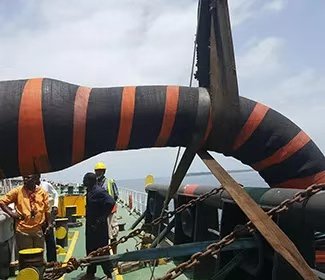
Core Standards and Scope of Application It is crucial to clearly define the type of slurry discharge pipes and applicable standards before construction. The main standards involved are as follows: | Standard Name | Standard Number | Scope of Application / Transport Medium | Key Differences | |—————|—————–|—————————————–|—————–| | Self-floating Slurry Discharge Rubber Hoses and […]
How to select the buoyancy of semi-floating rubber hoses
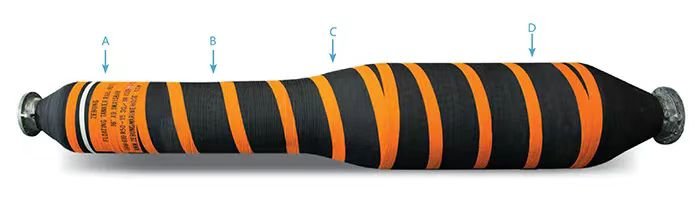
Core Concept: What is ‘Semi-Self-Floatation’? First, it is important to clarify the meaning of ‘semi-self-floatation’. It refers to a rubber pipe that, after being filled with a medium (such as water, mud, etc.), has insufficient buoyancy on its own to completely counteract gravity and float on the water surface; instead, it partially suspends in the […]
The function of semi-floating rubber hoses
I. Core Definition and Working Principle Core Definition: A semi-self-floating rubber hose is a type of hose designed for use in water bodies (such as oceans, rivers, lakes). Its ‘semi-self-floating’ characteristic means it cannot float entirely on the water surface; instead, most of it is submerged underwater, with a portion exposed above the water. Working […]
Common Problems and Solutions for Semi-Float Pipes
🔍 About ‘Semi-Self-Flotation Pipes’ and Their Potential Issues ‘Semi-self-flotation pipe’ is not a standard engineering term. It may refer to pipes with certain self-flotation capabilities or pipe systems that exhibit upward floating phenomena under specific operating conditions (such as high groundwater levels). According to available information, the main situations are as follows: • Floating pipe […]
Maintenance and Care of Semi-Float Rubber Pipes
Maintaining and servicing semi-floating rubber hoses requires a focus on standardized daily operations, regular detailed inspections, and creating a suitable storage environment. Below is a table summarizing the main maintenance and service key, along with some additional details not covered in the table: Daily Use Work Pressure Avoid exceeding the specified work pressure, prevent sudden […]
Disadvantages of semi-floating rubber hoses
Semi-self-floating rubber hoses can provide buoyancy and flexibility in specific applications, but they also have some obvious drawbacks. To help you understand quickly, I will summarize the main disadvantages of semi-self-floating rubber hoses and their underlying reasons in a table: 🛠️ Complex structure with high maintenance cost. The multi-layer composite structure may result in the […]
Advantages of Semi-Float Rubber Tubes
Semi-self-floating rubber hoses are highly practical industrial pipe materials that combine the advantages of multiple materials, offering significant benefits in specific application scenarios. Simply put, a semi-self-floating rubber hose is a composite pipe with an internal rubber layer, an external buoyancy material (such as polyurethane foam or polyethylene foam), and a wear-resistant outer rubber layer. […]
Application scenarios of semi-floating rubber hoses
Semi-self-floating rubber hoses are highly practical industrial hoses that combine the excellent properties of rubber with the characteristics of built-in buoyancy materials. Their core feature is: they can float on the water surface when empty or filled with a lighter medium, and sink partially or completely into the water when filled with a heavier medium […]
Analysis of the Structure and Properties of Semi-Float Rubber Tubes
Semi-self-floating rubber hoses are specially designed soft tubes for conveying media (such as oil, water, sludge, etc.) in water or underwater. The name \”semi-self-floating\” reveals its core characteristic: it has a certain buoyancy itself, but it is not sufficient to make the entire tube float completely on the water surface; usually, additional floating bodies are […]
Analysis of Characteristics and Applications of Semi-Float Rubber Tubes
Basic Definition: A rubber hose specifically designed for water-based operations. It can float partially or entirely on the water surface due to built-in buoyancy materials or special structures, facilitating the conveyance of liquids or mixtures. Main Types Oil Pipeline: Used for transporting crude oil, petroleum products, etc., between offshore vessels and mooring systems . Slurry […]