Advantages of Semi-Float Rubber Tubes
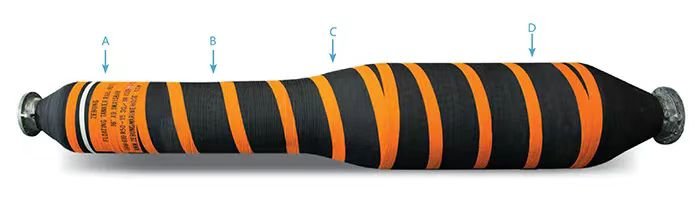
Semi-self-floating rubber hoses are highly practical industrial pipe materials that combine the advantages of multiple materials, offering significant benefits in specific application scenarios. Simply put, a semi-self-floating rubber hose is a composite pipe with an internal rubber layer, an external buoyancy material (such as polyurethane foam or polyethylene foam), and a wear-resistant outer rubber layer. Unlike fully self-floating pipes that float entirely on the water surface or ordinary rubber hoses that sink completely to the bottom, it partially floats in the water and partially protrudes above the surface. Its core advantages are mainly reflected in the following aspects:
1. Excellent Buoyancy and Operability
– Easy deployment and recovery: Compared to heavy rubber hoses that sink completely, semi-self-floating hoses are lightweight in water, requiring only minimal pulling force for dragging and deployment, significantly reducing labor intensity and operation time.
– Visible position: Part of the pipe body protrudes above the water, allowing operators to easily track and locate the pipeline direction, avoiding accidental collisions with boats or underwater equipment.
– Adaptability to water level changes: In tidal or wave-prone waters, semi-self-floating hoses can naturally rise and fall with water level changes, reducing stress caused by water level fluctuations and preventing pipe distortion or excessive stretching.
2. Superior Durability and Wear Resistance
– Multi-layer structure protection: Typically consisting of an inner rubber layer, reinforcement layer (such as high-strength synthetic fibers or steel wires), buoyancy layer, and wear-resistant outer rubber layer. This structure enables it to withstand higher internal working pressure and effectively resist external impacts, friction, and ultraviolet aging.
– Wear-resistant outer rubber layer: A specially designed wear-resistant outer rubber layer can resist wear from sharp or rough objects such as underwater rocks, gravel, and dock edges, extending service life.
3. Wide Environmental Adaptability
– Corrosion resistance: Rubber and external buoyancy materials are resistant to seawater, freshwater, oils, and various chemicals, making them less prone to corrosion and rust.
– Strong weather resistance: They can adapt to different climatic conditions from tropical to polar regions, maintaining good flexibility at both high and low temperatures.
– Reduced biofouling: Due to the pipe body being in a moving or semi-suspended state in water with a smooth surface, compared to fixed pipes, they are less likely to be colonized by aquatic organisms such as shellfish, reducing maintenance costs and water flow resistance.
4. Multifunctionality and High Cost-Effectiveness
– Multi-purpose use: Can be used to convey various media, such as seawater, freshwater, sewage, sludge, air, and even some light oil products.
– Cost savings:
– Low installation cost: No need for complex anchoring or ballast systems as required for submerged pipes.
– Low maintenance cost: Strong durability reduces replacement frequency and repair expenses.
– Low operating cost: Due to its smooth inner wall and reasonable buoyancy design, fluid resistance is relatively small, helping to reduce conveying energy consumption.
5. Safety and Reliability
– Prevention of kinking and flattening: It usually has an internal reinforcing skeleton (such as steel wire spiral) that can effectively maintain the pipe shape, preventing it from collapsing or kinking even under negative pressure or external squeezing, ensuring smooth medium flow.
– High strength and tensile resistance: It can withstand pulling forces during operations and wave impact forces, ensuring high safety.
Main Application Scenarios
Based on the above advantages, semi-floating rubber hoses are widely used in:
1. Dredging Engineering: Connecting dredgers and slurry discharge pipes to convey mud and sand mixtures, which is their most classic application.
2. Marine Engineering and Offshore Operations: Used for offshore construction, water supply for drilling platforms, cooling water conveyance, etc.
3. Firefighting Water Supply: Serving as temporary water main for water-based firefighting, providing water sources for shore-based fire trucks or fireboats.
4. Agricultural Irrigation: Pumping water from sources (rivers, lakes) for large-area irrigation.
5. Emergency Drainage: Used for emergency drainage in urban flooding, mine pits, and construction sites.
6. Industrial Fields: Conveying industrial wastewater, circulating water, etc.
Summary
In summary, the advantage of semi-floating rubber hoses lies in their perfect balance of ‘buoyancy’, ‘strength’, ‘durability’, and ‘operability’. Although they are not fully floating, this ‘semi-floating’ state makes them more stable than fully floating hoses and easier to operate than submerged hoses, making them an efficient, economical, and reliable fluid conveying solution in various harsh aquatic and amphibious environments. When selecting, appropriate specifications should be chosen based on specific working pressure, medium characteristics, environmental conditions, and pipe diameter requirements.