Application scenarios of semi-floating rubber hoses
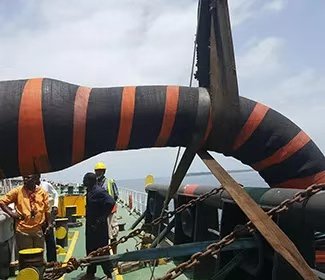
Semi-self-floating rubber hoses are highly practical industrial hoses that combine the excellent properties of rubber with the characteristics of built-in buoyancy materials. Their core feature is: they can float on the water surface when empty or filled with a lighter medium, and sink partially or completely into the water when filled with a heavier medium (such as water).
This unique performance makes them very popular in the following application scenarios:
1. Water and maritime engineering (core application area)
1. Sand suction and dredging on water
◦ Application description: This is the most classic application of semi-self-floating rubber hoses. They are used by sand suction ships and dredgers to transport the mixture of mud and sand (slurry) from the riverbed or seabed to designated areas.
◦ Advantages: The buoyancy supports the pipe, preventing it from sinking completely, thus avoiding being buried by mud and sand or hooked by underwater obstacles, making it easy to drag and move. The rubber material is wear-resistant and corrosion-resistant, able to withstand the abrasion of sand and mud.
2. Oil spill recovery and containment at sea
◦ Application description: Used to connect offshore oil spill recovery equipment to transport the recovered oil-contaminated mixture.
◦ Advantages: It can float on the water surface, facilitating deployment and recovery. Rubber has good tolerance to various types of oil, preventing pipeline damage from oil contamination.
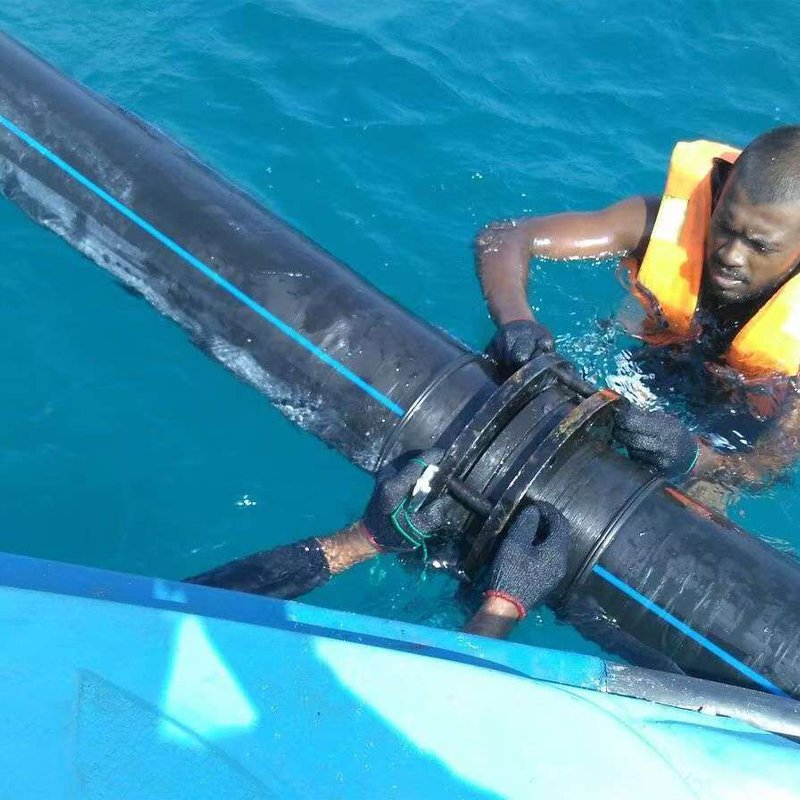
3. Seawater cooling water conveyance
◦ Application description: Used in coastal factories, power stations, or large ships to draw cooling water from the sea or discharge heated cooling water back into the sea.
◦ Advantages: The floating property makes installation and maintenance easy. Rubber hoses can resist seawater corrosion and marine organism attachment.
4. Offshore construction and supply
◦ Application description: Temporarily convey fresh water, fuel, or other liquid supplies to remote islands, drilling platforms, or construction vessels away from the coast.
◦ Advantages: It can quickly lay a temporary \”lifeline\” on the water surface with extremely high flexibility. 2. Industry and mining
1. Mine tailings conveyance
◦ Application description: In mining areas, used to convey tailings slurry generated after ore dressing to tailings ponds. The route may involve crossing ponds, lakes, or rivers.
◦ Advantages: When crossing water bodies, its buoyancy eliminates the need for expensive and complex overhead support structures, allowing direct floating conveyance on the water surface. Its wear resistance is also suitable for abrasive tailings.
2. Industrial wastewater and sludge treatment
◦ Application description: Used in large factories, wastewater treatment plants, or environmental remediation projects to convey industrial wastewater, sedimentation tank sludge, etc.
◦ Advantages: When the conveyance route needs to cross ponds or ditches, semi-self-floating hoses provide great convenience. Their chemical corrosion resistance is also applicable to various industrial wastewaters.
III. Agriculture and Water Conservancy
1. Agricultural Irrigation and Drainage
• Application Description: Used in large farms and aquaculture farms to draw water from reservoirs and rivers for irrigation, or to drain water from low-lying areas and ponds.
• Advantages: Floats on the water surface, with the water intake position easy to control, not prone to sinking into mud. Easy to move and reposition.
2. Emergency Flood Control and Drainage
• Application Description: Used during flood disasters to quickly drain urban rainwaterlogging or farmland(shuǐjī, standing water).
• Advantages: Can be rapidly deployed in waterlogged areas. Due to its buoyancy, it does not fail due to changes in water depth, and has strong mobility.
IV. Other Special Applications
1. Buoyancy Support for Floating Bridges or Temporary Passages
• Application Description: Sometimes a large number of closely arranged semi-self-floating rubber tubes are used as the buoyancy foundation for temporary floating bridges or work platforms.
• Advantages: Provides stable buoyancy and is inherently tough and durable.
2. Firefighting Water Supply
• Application Description: In forest firefighting or specific area firefighting, when it is necessary to draw water from natural sources such as lakes and rivers over long distances, semi-self-floating tubes can be used.
• Advantages: Quick to lay, highly visible (facilitating checks for patency), and adaptable to complex terrains.
Summary: Advantages of Semi-Self-Floating Rubber Tubes
• Buoyancy and Self-Regulation: Can automatically adjust its position in water according to the weight of the internal medium, avoiding sinking to the bottom.
• High Abrasion and Corrosion Resistance: Suitable for conveying abrasive and corrosive media, with a long service life.
• Flexibility and Easy Deployment: Easy to roll, transport, and quickly deploy, with high mobility.
• High Strength and Good Pressure Resistance: Can withstand certain internal and external pressures, suitable for pumping conditions.
• Wide Environmental Adaptability: Can be used in various environments such as seawater, freshwater, oils, and acid-base solutions.
In summary, semi-self-floating rubber tubes are an ideal tool for solving the problem of \”transporting liquids/suspensions across water bodies or marshy areas\”. Their value is particularly prominent in working conditions requiring abrasion resistance, corrosion resistance, and ease of movement.