The function of semi-floating rubber hoses
I. Core Definition and Working Principle
Core Definition:
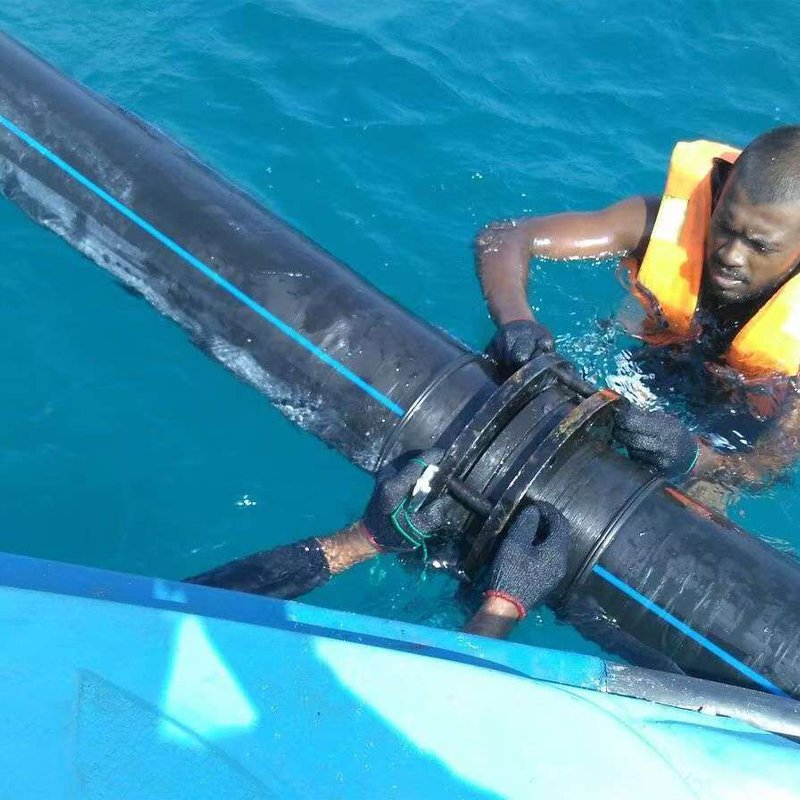
A semi-self-floating rubber hose is a type of hose designed for use in water bodies (such as oceans, rivers, lakes). Its ‘semi-self-floating’ characteristic means it cannot float entirely on the water surface; instead, most of it is submerged underwater, with a portion exposed above the water.
Working Principle:
This characteristic is achieved through its special structural design:
1. Buoyancy Layer: A buoyancy layer made of lightweight, high-buoyancy materials (such as closed-cell foam plastic, foamed rubber, etc.) is embedded within the hose wall.
2. Balance of Gravity and Buoyancy: The inherent weight of the rubber hose (including the lining, reinforcement layer, and outer rubber layer) causes it to sink. Meanwhile, the built-in buoyancy layer provides upward buoyancy.
3. ‘Semi-floating’ State: Through precise calculation by designers, the buoyancy and gravity do not completely cancel each other out. The result is that the hose lies in a gentle arc or nearly horizontal position underwater, but the ends or certain sections are exposed above the water, forming a visible marker.
II. Main Functions
The core function of the semi-self-floating rubber hose is to ‘establish a stable, reliable, and easily manageable waterborne or underwater conveying channel.’ This is specifically manifested as:
1. Providing Buoyancy Support:
– Prevents the hose from fully sinking to the bottom, avoiding friction, compression, and damage from sharp rocks, reefs, sunken ships, or underwater debris, thereby significantly extending its service life.
– Keeps the hose in a relatively gentle bending arc, reducing increased flow resistance and structural fatigue caused by sharp bends or kinks.
2. Maintaining Preset Position and Shape:
– In waves and currents, semi-self-floating hoses are more stable than fully floating or fully submerged hoses. They are less likely to be carried away by waves and can better maintain the preset conveying path.
– The characteristic of having a portion exposed above the water makes them easier for ships to identify and avoid during marine operations, serving as a safety warning.
3. Adapting to Complex Sea Conditions:
– Compared to fully floating hoses, semi-self-floating hoses experience less direct impact from surface wind and waves because most of them are underwater. This makes them more survivable in harsh sea conditions.
– They can move up and down moderately with waves, absorbing some energy to prevent damage from rigid pulling.
III. Prominent Features
• High Stability: Positioned between floating and submerged states, it has strong resistance to wind, waves, and current interference.
• Wear-resistant: Avoids direct contact with the seabed, protecting the hose body.
• Easy to Identify and Operate: The exposed portion provides a visual reference for operators, facilitating deployment, recovery, and maintenance.
• Strong Durability: Typically made from high-quality rubber and reinforcing materials (such as high-strength synthetic fibers or steel wires) that are resistant to seawater corrosion, ultraviolet rays, oil, and chemicals.
• Good Flexibility: Despite its sturdy structure, it retains sufficient flexibility for easy coiling and storage on operational vessels and deployment.
IV. Typical Application Scenarios
The semi-self-floating rubber hose is a key equipment in the following fields:
1. Marine Liquid Cargo Transfer:
• Ship-to-ship Barging: Transporting petroleum products such as fuel oil and diesel between two berthed ships. This is the most common application scenario.
• Shore-to-Ship Fueling: Delivering fuel from shore or a bunkering barge to berthed ships.
• Marine Rescue and Supply: Providing emergency fuel supply to marine vessels or platforms.
2. Waterborne Construction and Dredging:
• Connecting dredgers and slurry pipelines for transporting mixtures of mud and silt. Its semi-floating characteristics allow it to adapt to dynamic distance changes between the dredger and the discharge point.
3. Offshore Engineering and Emergency Response:
• Used for temporary connections to transport fire water, chemicals, or as emergency discharge pipes.
• In oil spill emergency response, it can be used to deploy oil booms or connect oil recovery equipment.
4. Temporary Water Supply:
• Providing temporary fresh water supply between islands or from shore to water-based facilities.
Summary
In summary, the core value of the semi-self-floating rubber hose lies in its clever balance between ‘floating’ and ‘sinking’. It utilizes buoyancy to protect itself and facilitate operation, while partially submerging to achieve better stability and environmental adaptability. This design makes it an indispensable, efficient, and safe solution for fluid transfer tasks in marine and inland water environments.