Construction Recommendations and Standards for Semi-Self-Float Rubber Pipes
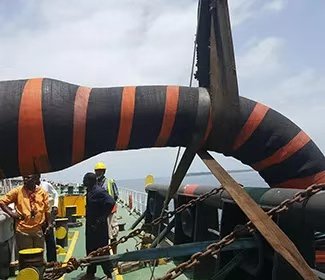
Core Standards and Scope of Application It is crucial to clearly define the type of slurry discharge pipes and applicable standards before construction. The main standards involved are as follows:
| Standard Name | Standard Number | Scope of Application / Transport Medium | Key Differences |
|—————|—————–|—————————————–|—————–|
| Self-floating Slurry Discharge Rubber Hoses and Hose Assemblies | GB/T 37221-2018 | Mixtures of seawater, freshwater, sludge, clay, sand, coral reefs, and gravel | Has a broader scope of application and allows for the transport of more abrasive media. |
| Self-floating Rubber Slurry Discharge Pipes | JT/T 1217-2018 | Mixtures of seawater, freshwater, sludge, clay, and sand | Has a narrower scope of application and explicitly does not apply to the transport of gravel, flaky weathered rock, and coral reefs. |
Construction Recommendations: First, select the appropriate product standard by referring to the above table based on the medium to be transported in your project. This directly relates to the material, structure, and durability design of the slurry discharge pipes.
General Construction and Technical Management要点 Although detailed construction procedures are lacking, the following technical requirements based on standards are key to ensuring construction quality and safety.
1. Pre-construction Inspection and Preparation
– Appearance and Dimensional Inspection: Before installation, each slurry discharge pipe should undergo an appearance inspection to ensure there are no defects in the pipe body. At the same time, general measuring tools should be used to check dimensional tolerances to confirm compliance with design requirements.
– Performance Confirmation: Ensure that the slurry discharge pipe has passed the static hydraulic test and can withstand the rated working pressure. This is a basic requirement to ensure that the pipe does not rupture during slurry transportation.
– Documentation and Markings: Verify the permanent markings on the pipe body, which should include the manufacturer, specifications (inner diameter, rated pressure), production date, and standard number being implemented. Ensure that the products used come with valid factory inspection reports.
2. Installation and Connection
– Fitting Connection: Ensure that pipe fittings such as flanges are securely connected. Standards require testing the bonding strength between metal and rubber layers of fittings; during construction, check that there are no abnormalities at the connection points.
– Bending Radius Control: When laying, attention should be paid to controlling the bending angle. Standards mention bending tests; during construction, avoid exceeding the product’s allowable bending limit to prevent damage to the pipe body structure.
– Floating State Adjustment: The ‘self-floating’ capability depends on the floating layer material inside. During construction, avoid sharp objects piercing or scratching the pipe body, which could damage the buoyancy units. For ‘semi-self-floating’ types, additional float boxes or counterweights may be required, which must be strictly implemented according to the design.
3. Operation and Maintenance
– Pressure Control: During operation, the pressure of the transported medium should not exceed the rated working pressure of the slurry discharge pipe and should stay away from the爆破 pressure safety boundary.
– Environment and Medium: Pay attention to the environmental temperature range specified by the standard (e.g., -20℃~+45℃ for GB/T 37221-2018) and medium density range. Avoid extreme environments or transporting media beyond the specified limits to prevent accelerated pipeline aging and wear.
– Welding Quality: If fittings involve welding, ensure that the welding quality meets relevant material and welding specifications.
4. Transportation and Storage
– The transportation and storage of slurry discharge pipes should follow the requirements of GB/T 9577 and GB/T 9576, which typically include avoiding heavy pressure, impact from sharp objects, exposure to sunlight, and contact with harmful chemicals.
Important Reminder: Since ‘semi-floating’ may involve non-standard design or specific applications, the above suggestions based on standard products are general in nature.
• First, follow the design documents: In actual projects, you must take the construction drawings and technical requirements provided by the design unit as the highest authority.
• Consult the manufacturer: The most reliable construction advice should come from the manufacturer of the sludge discharge pipe. They can provide installation, usage, and maintenance guidelines tailored to specific product models.
I hope the above information can provide you with valuable reference. If you can provide more specific application scenarios or details of the problems encountered, I might be able to help you find more in-depth information.