Maintenance Guide for Live Flange Dredging Rubber Hoses
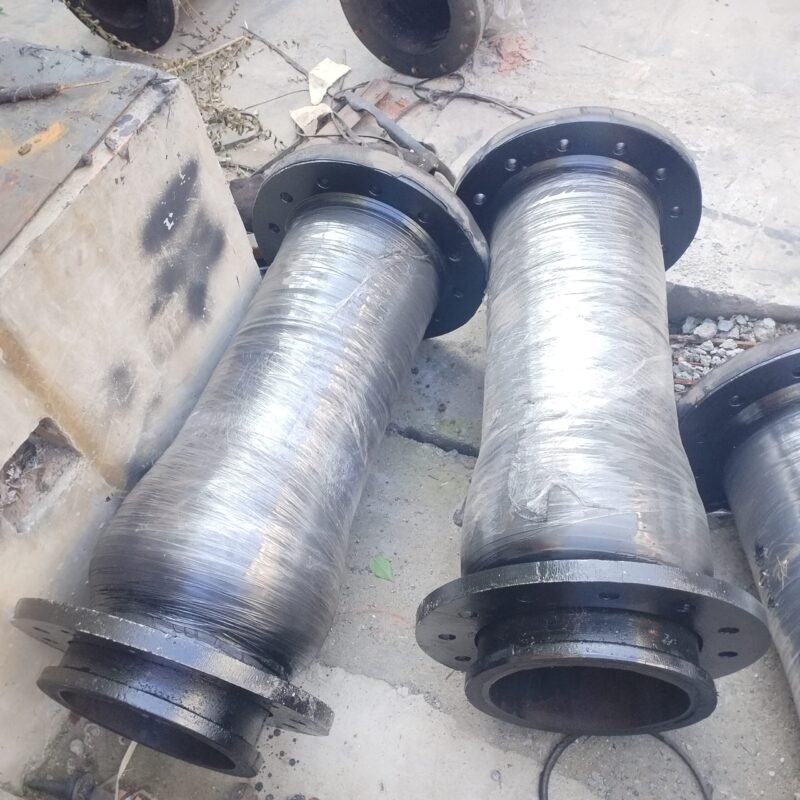
For live flange dredging rubber hoses, maintenance and upkeep are comprehensive tasks. The core lies in standardized installation, regular inspections, creating a suitable operating environment, and timely replacement when aging or damage occurs.
To help you quickly grasp the key points, I have summarized the core maintenance operations in the following table:
Project Key Requirements/Inspection Standards Hazard/Purpose
Explanation Installation Specifications
Ensure flange alignment and parallelism;Strictly prohibit forced installation.
To prevent rubber hoses from withstand abnormal torque leading to seal failure or joint damage.
Pressure Control
Avoid sudden pressure changes, pressure peaks, or use exceeding rated pressure.
Sudden pressure changes can significantly shorten hose life and even cause instantaneous rupture.
Bending Radius
During installation and operation,Strictly prohibit bending below the minimum bending radius specified by the manufacturer.
Excessive bending will seriously damage the reinforcement layer, resulting in permanent reduction of pressure-bearing capacity and early failure.
Environmental Protection
Avoid direct sunlight and rain, and stay away from heat sources, oils, and acid-base chemicals.
Ultraviolet rays, ozone, and chemical media accelerate rubber aging and cracking.
Routine Inspection
Conducted at least once a year by qualified personnel.
To promptly identify potential issues and prevent safety accidents such as leaks and ruptures.
Post-Use
Cleaning After use, empty the medium inside the hose and perform internal cleaning if necessary.
To prevent residues from corroding the inner rubber layer or causing blockages due to deposits.
Storage Requirements
When not in long-term use, store in an environment of 10-25°C, dry, and light-shielded, and lay flat to avoid deformation from stacking.
Improper storage accelerates rubber aging and causes performance degradation before use.
🔍 Daily Inspection and Fault Diagnosis
According to the recommendations of German occupational safety regulations, daily inspections should be carried out by qualified personnel at least once a year. You can focus on checking the following points:
• Visual inspection: Check for cracks (especially transverse cracks), blisters, cuts, wear exposing the reinforcement layer in the outer rubber layer.
• Leakage check: Inspect the pipe body and flange connections for any leakage.
• Connection and fitting check: Ensure that flange fittings have no severe corrosion or deformation, and that the rubber hose is not pulled out from the joint.
• Deformation check: Observe whether there is abnormal flattening, twisting, or permanent bending in the rubber hose in its natural state or under pressure.
⚠️ Safety Precautions and Disposal
• No repairs allowed: Once a rubber hose assembly is damaged, it must be replaced as a whole; repairs are strictly prohibited. Reassembling with old parts is also not allowed.
• Recommended service life: Although service life is greatly affected by operating conditions, a commonly used reference replacement cycle is 6 years in the absence of specific manufacturer instructions. If the rubber hose has exceeded the manufacturer’s recommended maximum storage period (generally four years), even if unused, a strict inspection and evaluation should be conducted.
• Do not use if markings are unclear: For hoses with unknown origin or incomplete marking information (such as missing model, maximum working pressure, production date), for safety reasons, their use should be avoided.
💎 Important Additional Notes
For the specific application scenario of \”dredging\”, special attention is also needed:
• Medium compatibility: Ensure that the inner material of the rubber hose can withstand the wear and corrosion caused by dredging materials (such as seawater, mud and sand, and possible chemicals).
• Motion compensation: In dredging operations, relative motion between the vessel and the pipeline is frequent. During installation, ensure that the rubber hose has sufficient free length and flexibility to compensate for these displacements, avoiding additional stretching, squeezing, or torsion.
Please note that in actual operation, the official technical manual provided by the manufacturer of the rubber hose you are using should always be the highest guiding standard.
If you can provide the specific brand, model of the rubber hose, or working environment (such as conveying medium, pressure range, etc.), I can analyze more specific precautions for you.