How to testing the thickness of polyethylene (PE) floats?
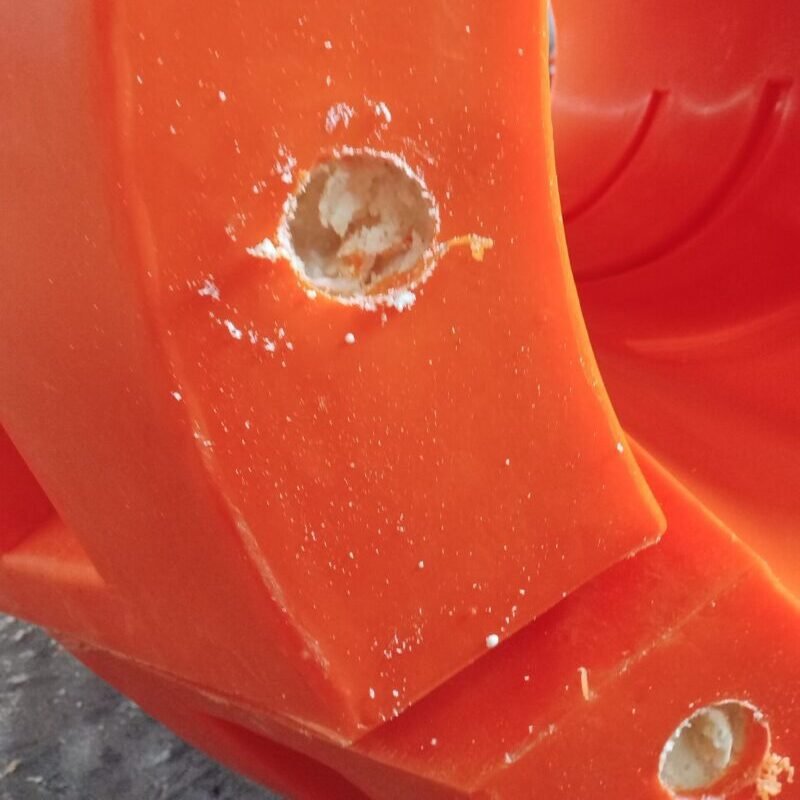
Testing the thickness of polyethylene (PE) floats is crucial for ensuring their quality and performance, especially in applications such as marine, aquaculture, and docks. Here are several common testing methods:
1. Ultrasonic Thickness Gauge
• Principle: Uses the speed and time difference of ultrasonic waves traveling through the material to measure thickness.
• Steps: 1. Clean the float surface to ensure it is free from dirt or unevenness. 2. Place the ultrasonic thickness gauge probe vertically against the float surface. 3. The instrument will display the thickness reading.
• Advantages: Non-destructive, fast, portable.
• Note: Calibrate the instrument and ensure correct material density and sound velocity settings.
2. Measuring with calipers or micrometers
• Applicable scenarios: Suitable for small floats or cuttable samples. • Steps: 1. Measure the edge or cross-section of the float directly with calipers or micrometers. 2. Take multiple measurements and average them to improve accuracy.
• Disadvantages: Destructive (requires cutting samples), suitable only for local measurements.
3. Optical thickness gauges (such as laser distance meters)
• Principle: Measures the distance from the surface to the substrate using laser reflection.
• Applicable scenarios: Floats with flat surfaces.
• Advantages: Non-contact, but precision may be affected by surface reflectivity.
4. Section sampling method (laboratory testing)
• Steps: 1. Cut a small sample from the float. 2. Measure the thickness of the section using a microscope or precise instruments.
• Advantages: High precision, suitable for quality control.
• Disadvantages: Destructive, requires specialized equipment.
5. X-ray or CT scanning (industrial-level testing)
• Applicable scenarios: High precision requirements or complex structures of floats.
• Advantages: Can obtain internal thickness distribution, non-destructive.
• Disadvantages: High cost, requires specialized equipment.
6. Magnetic thickness gauge (only applicable to composite floats with metal substrates)
• Principle: Measures coating thickness using magnetic adhesion force.
• Note: Not suitable for pure polyethylene floats. Considerations • Multiple measurements: Floats may have uneven thickness, so it’s advisable to measure at different locations multiple times.
• Standard reference: Refer to industry standards (such as ISO, ASTM) or customer tolerance ranges.
• Environmental factors: Temperature changes may affect measurement results (especially with ultrasonic methods). Recommended methods
• On-site quick testing: Ultrasonic thickness gauge (most commonly used).
• Laboratory precise analysis: Sectioning or CT scanning. Select an appropriate method based on actual needs to ensure the float thickness meets design specifications and usage requirements.