How to Select Suction Rubber Hoses
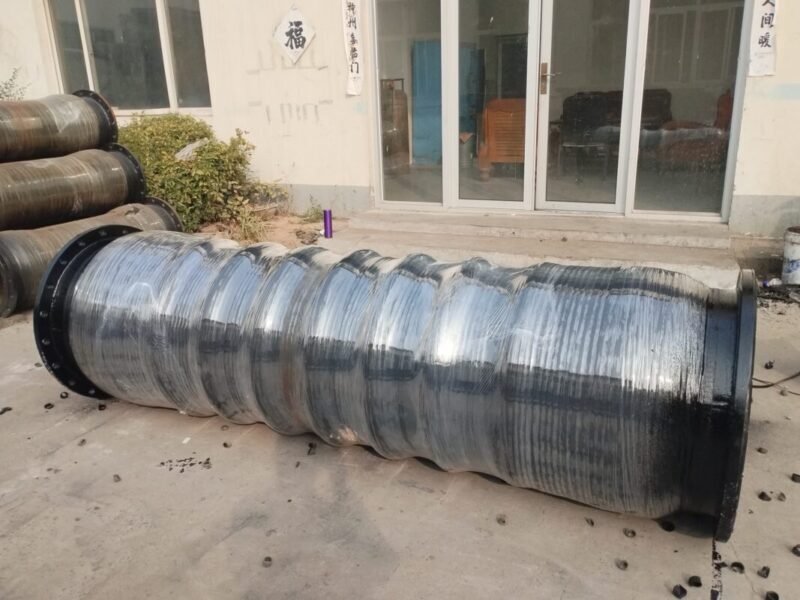
When selecting suction rubber hoses, consider factors such as operating conditions, material properties, structural design, and cost-effectiveness. Here are specific selection points:
1. Clarify Operating Requirements
• Medium Type: Determine if it’s slurry (containing particles), clear water, corrosive liquids, or other mixtures. Slurry requires wear resistance, while chemical liquids need corrosion resistance.
• Working Pressure: For high-pressure conditions (e.g., deep-water suction), choose reinforced layers (such as wire-braided) high-pressure hoses; for low-pressure scenarios, use ordinary fiber-layer hoses.
• Temperature Range: For high-temperature environments (e.g., industrial wastewater), use heat-resistant rubber (such as EPDM); for low temperatures, use cold-resistant formulations (such as silicone rubber).
• Bending Frequency: For frequent movement or bending (e.g., dredging ships), select flexible hoses to avoid rapid internal structure fatigue.
2. Material Selection
• Inner Liner:
◦ Natural Rubber (NR): Good abrasion resistance, suitable for slurry and sand.
◦ Nitrile Rubber (NBR): Strong oil resistance, suitable for oily wastewater.
◦ Chloroprene Rubber (CR): Resistant to ozone and aging, more durable outdoors.
◦ EPDM Rubber: Resistant to acids and alkalis, withstands high temperatures (up to 120°C), suitable for chemical wastewater.
• Outer Layer: Prefer materials with UV and aging resistance (such as CR or rubber with protective agents), prevent cracking when used outdoors.
3. Structural Design
• Reinforcement Layer:
◦ Fiber Braiding/Wrapping: Suitable for medium-low pressure (e.g., 0.6-1.2MPa), lower cost.
◦ Steel Reinforcement: For high-pressure scenarios (e.g., above 1.5MPa), resistant to collapse and stretching.
• Tube Wall Thickness: For large slurry particles or high flow rates, choose thicker inner liners (e.g., 4-6mm) to extend lifespan.
• Connector Types: Flange connections (for fixed installations), quick couplings (for frequent disassembly), threaded connectors (for small-diameter high-pressure), must match equipment interfaces.
4. Key Performance Parameters
• Abrasion Resistance: ASTM D3389 standard test, select high abrasion resistance levels (e.g., volume loss ≤90mm³).
• Pressure Rating: Use 1.5 times the working pressure as a safety margin (e.g., actual pressure 0.8MPa, select 1.2MPa hose).
• Bend Radius: For dynamic use, the bend radius should be less than five times the hose outer diameter (e.g., DN100 hose bend radius ≤500mm).
5. Brand and Certification
• Renowned Brands: Such as Continental, Gates, Yokohama, etc., ensuring quality.
• Certification Standards: Pass ISO 9001, MSHA (mine safety), or FDA (food grade) certifications to ensure compliance.
6. Economy and Maintenance
• Cost Consideration: For long-term heavy-duty use, choose higher-priced durable options; for short-term projects, opt for economical types.
• Maintenance Convenience: Hoses with scale markings on the outer layer facilitate checking wear, rotatable connectors reduce twisting damage.
Example Scenario Selection
• River Dredging: Use steel-reinforced NR inner liner hose (e.g., DN150, pressure 1.0MPa), flange connection.
• Chemical Plant Sludge: EPDM inner liner + CR outer layer, resistant to acids, alkalis, and high temperatures, with quick couplings.
• Mine Tailings Transport: Ultra-abrasion-resistant NR hose + steel wrapping, withstands pressures over 2.0MPa.
• Installation Protection: Avoid friction with sharp objects, add sleeves if necessary.
• Regular Inspection: Monitor inner layer peeling, joint leakage, or outer layer cracks, replace promptly.
Following these steps ensures precise matching of requirements, guaranteeing efficient, safe, and economical operation of the hose.