Functional Analysis of Dredging Rubber Expansion Short Pipes
Core Definition:
Dredging Rubber Expansion Short Joint, also commonly known as rubber expansion joint, rubber compensator, or flexible coupling, is a special rubber pipe fitting with metal flanges installed between two rigid pipe sections in a dredging pipeline system. Its main function is to address various challenges faced by the pipeline system during dredging operations, ensuring the system operates safely, efficiently, and durably.
Main Function Analysis:
Here is a detailed breakdown of its core functions:
1. Compensating for Displacement and Misalignment Errors – Core Function
This is the primary function of the rubber expansion short joint. Dredging operations take place in complex environments, with pipelines often being long and located between ships and underwater pipelines or laid on uneven ground.
– Axial Compression and Tension: The heaving of ships, thermal expansion and contraction of pipelines, and inertial forces during start-up and shutdown cause minor changes in the length direction of the pipeline. The rubber short joint can be compressed or stretched like a spring to absorb these displacements, preventing rigid pipelines from being torn or jammed.
– Radial and Angular Offset: It is difficult to achieve absolute straightness when laying pipelines, and The connected pipe sections may have misaligned centerlines (misalignment) or angular deviation. The flexibility of rubber allows for a certain degree of radial and angular deflection, perfectly compensating for these installation errors to ensure smooth pipeline connection.
Simple Analogy: It is like the \”joints\” in our body, allowing arms and legs to move in multiple directions instead of being as rigid as a wooden stick.
2. Vibration Damping and Noise Reduction
The slurry pumped by dredging pumps often contains sand, gravel, and even rocks, with high and uneven flow rates, generating intense vibrations and loud noises.
– Damping Effect: Rubber is a high-damping material that can effectively absorb and isolate vibration energy generated by pumps and fluid pulsations.
– System Protection: It reduces vibration transmitted to the entire pipeline system and supporting structures (such as ship pipe racks, shore supports), protecting pumps, valves, and other equipment, extending their service life, and improving the working environment.
3. Absorbing Impact Loads
During dredging, large objects (such as stones, metal debris) are often sucked in, or sudden blockages and releases occur, creating a \”water hammer\” effect in the pipeline, generating instantaneous high-pressure shock waves.
– Buffering Effect: The elasticity of the rubber short joint acts like a safety airbag, cushioning and absorbing these sudden pressure peaks through slight deformation of itself, preventing damage to expensive pump bodies and rigid pipelines from the shock waves.
4. Adapting to Complex Operating Conditions
– Flexibility and Flexibility: At the \”hinged elbow\” connecting the dredger and the underwater slurry discharge pipeline, the flexibility of the rubber short joint is key to achieving specific angle conveyance.
– Wear Resistance: High-quality dredging rubber short joints are embedded with wear-resistant materials (such as ceramic tiles or ultra-high molecular weight polyethylene) internally, and their wear resistance is often better than that of ordinary steel pipes, protecting this vulnerable connection point.
Structural and Material Characteristics
To achieve the aforementioned functions, dredging rubber expansion joints have unique features in their design and manufacturing:
• Skeletal Layer: Usually composed of multiple layers of high-strength nylon fabric or steel cord fabric, providing pressure resistance to prevent excessive expansion or rupture under high pressure.
• Rubber Layers:
◦ Inner Rubber Layer: Directly in contact with abrasive slurry, typically made of extremely wear-resistant natural rubber or special synthetic rubber, and may include wear-resistant liners.
◦ Outer Rubber Layer: Exposed to the external environment, requiring resistance to weathering, ozone, and seawater corrosion.
• Flanges: Generally steel flanges, paired with pipe flanges for connection, requiring strict anti-corrosion treatment (such as epoxy coating, galvanization).
Application Scenarios
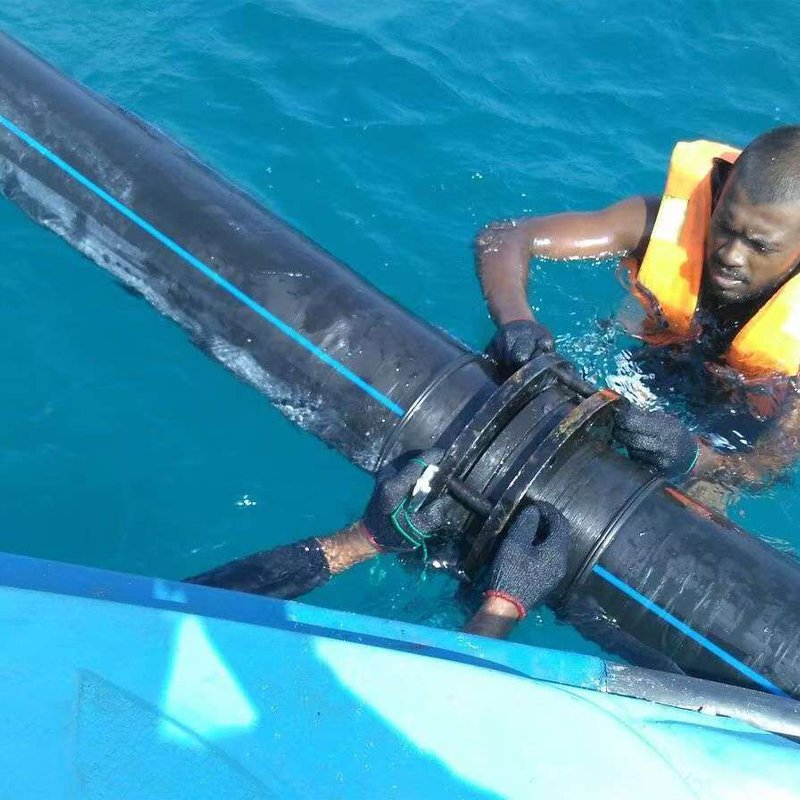
• Dredgers: Connecting the ship’s pipeline with underwater floating pipes or shore pipelines.
• Sand suction ships/mining ships: Serving as vibration-damping and compensation components in lifting pipeline systems.
• Shore-based slurry discharge pipelines: Installed at regular intervals along long-distance conveying systems to compensate for thermal displacement and foundation settlement.
• Equipment Inlets and Outlets: Installed at the inlet and outlet of mud pumps to protect the pump body from pipeline stress.
Summary
In short, dredging rubber expansion joints are not simple connecting pipes; they are multi-functional ‘safety guardians’ integrating displacement compensation, vibration reduction and noise suppression, impact absorption, and error correction. Through their own flexible deformation, they sacrifice themselves to protect the entire expensive dredging pipeline system, making them one of the key components to ensure continuous, smooth, and safe dredging operations.