Disadvantages of Live Flange Dredging Rubber Hoses
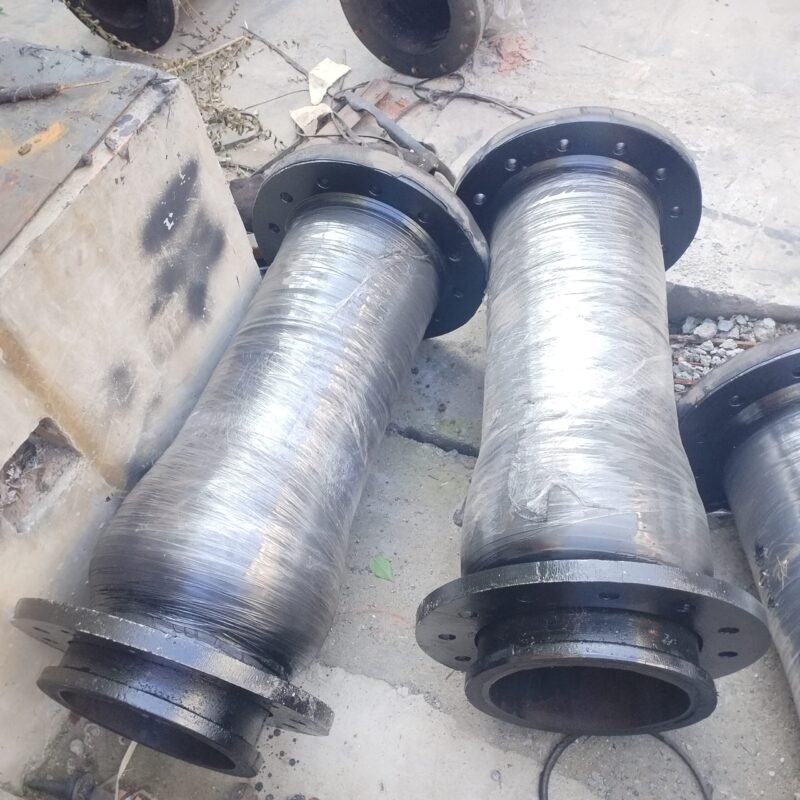
Disadvantages of Live Flange Dredging Rubber Hoses
1. Higher Initial Purchase Cost
• Disadvantage: High-quality ultra-wear-resistant dredging rubber hoses, due to their complex manufacturing processes and material costs, typically have a higher single-purchase price than ordinary steel pipes.
• Impact: Higher initial investment for the project.
2. Poor Resistance to Extreme Temperatures and Ultraviolet Rays
• Disadvantage: Rubber exposed to intense sunlight (ultraviolet rays) over a long period will accelerate aging, leading to issues such as cracking and hardening. Additionally, its temperature resistance range is limited, and it is generally not suitable for environments requiring continuous conveying of high-temperature media (e.g., >80°C).
• Impact: In cases of long-term outdoor storage or specific operating conditions, protective measures or rubber with special formulations must be adopted.
3. Limited Pressure-Bearing Capacity
• Disadvantage: Although it has strong pressure-bearing capacity, compared to thick-walled steel pipes of the same specification, its maximum working pressure still has a limit. In ultra-high-pressure dredging conditions, steel pipes or composite pipes with higher pressure ratings may still be required.
• Impact: Not suitable for certain special projects with extremely high pressure requirements.
4. Prone to Punctures or Cuts by Sharp Objects
• Disadvantage: While wear-resistant, its ability to resist punctures and cuts from sharp objects (such as rebar and rock edges) is inferior to that of steel. Once the outer rubber layer is cut, the reinforcement layer may be damaged, leading to overall pipe failure.
• Impact: Extra caution is needed in working conditions with a large amount of long metal objects or sharp rocks, or products with special anti-cut layers should be selected.
5. Certain Risk of Deformation
• Disadvantage: Under negative pressure (vacuum) conditions, if the pipe body support is insufficient, the rubber hose may collapse inward, affecting medium flow.
• Impact: Negative pressure conditions must be considered in pipe design and laying, and sometimes support rings need to be added.
Summary and Selection Recommendations
Features Advantages Disadvantages
Mechanical Properties Good flexibility, impact resistance, tensile strength Pressure capacity has an upper limit, may be punctured
Durability Wear-resistant, corrosion-resistant Not UV resistant, not heat resistant
Operability Lightweight, easy to install, convenient connection –
Economic Efficiency Long service life, low maintenance cost High initial procurement cost
Others Vibration and noise reduction May deform under negative pressure
Selection Recommendations:
• Prioritize live-flange dredging rubber hoses in the following situations:
◦ The working terrain is complex, requiring frequent bending and movement of the pipeline.
◦ The medium being transported is highly abrasive (e.g., sand, gravel, slag).
◦ The project requires frequent relocation with high demands on installation and disassembly efficiency.
◦ The working environment is seawater or a corrosive environment.
◦ Vibration reduction and noise reduction are required.
• Consider using steel pipes or other types of pipes in the following situations:
◦ The working pressure is extremely high, exceeding the bearing capacity of rubber hoses.
◦ The medium temperature is too high.
◦ The budget is very tight, and there is no high requirement for pipeline flexibility.
◦ The working conditions contain a large number of sharp foreign objects that may cut the pipe.
In summary, live-flange dredging rubber hoses are a high-performance, efficient, and flexible dredging conveying solution. Their advantages are very prominent in most dredging scenarios. Although the initial cost is higher, their long service life and low maintenance cost often result in better overall economic benefits. When selecting, the specific engineering requirements, medium characteristics, and budget should be balanced.