Detailed Explanation of the Structural Composition of Polyethylene Floating Bodies
I. Material Composition
The core material of the polyethylene float is polyethylene, but it is usually not pure polyethylene alone, but a modified composite material.
1. Main Base Material: Polyethylene
◦ Type: High-density polyethylene (HDPE) is mainly used. This is because HDPE has excellent corrosion resistance (to seawater, oils, and chemicals), high impact strength, good UV resistance, and relatively low density, which can provide sufficient buoyancy.
◦ Form: Linear low-density polyethylene is typically blended with HDPE to improve its environmental stress cracking resistance and toughness.
2. Key Additives (Modified Components)
To adapt to harsh marine or freshwater environments, the performance of pure polyethylene is insufficient, so various additives need to be added for modification:
◦ UV Stabilizers: Prevent the breakdown of polyethylene molecular chains caused by ultraviolet rays in sunlight, thus preventing aging, brittleness, and cracking. This is an essential additive for long-term outdoor use.
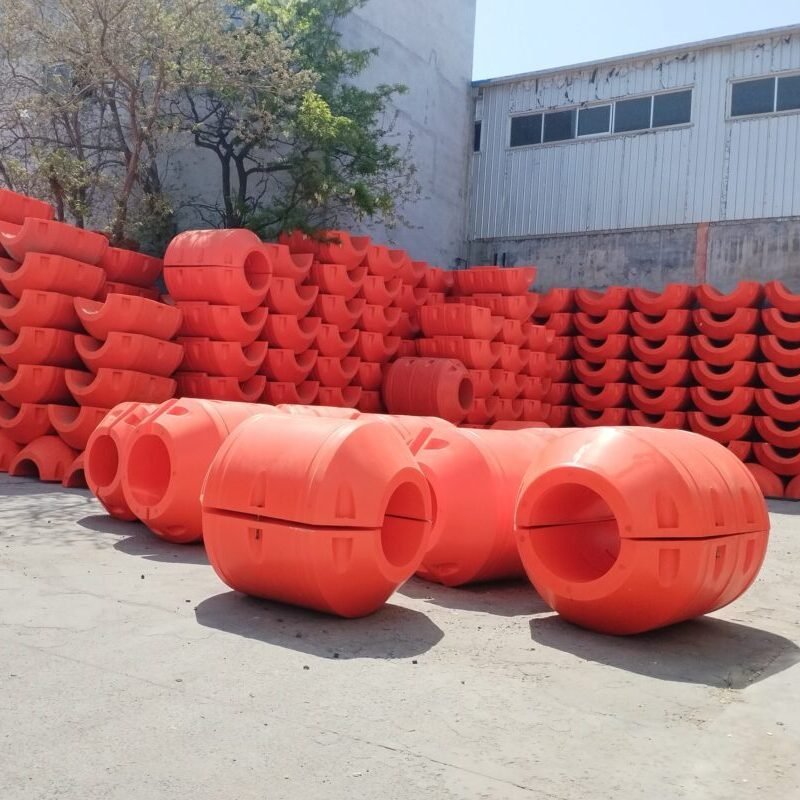
◦ Color Masterbatches: Provide various colors (such as orange, yellow, blue, etc.). Orange is the most common because it is very conspicuous in water, serving as a warning and identification function. Color masterbatches also need to have UV resistance.
◦ Blowing Agents: For foamed polyethylene floats, blowing agents are added to the plastic to form tiny closed pores inside. This structure makes it lower in density, higher in buoyancy, and even if the outer shell is damaged, it will not sink due to water ingress.
◦ Antioxidants: Slow down the decline in performance of plastics during processing and use caused by oxidation.
3. Internal Fillers
◦ Foamed Polyurethane Foam: This is a very common structure. The outer shell is hard HDPE plastic, and the interior is filled with high-density, closed-cell polyurethane foam. This design combines the wear resistance and corrosion resistance of HDPE with the unsinkability of the foam. Even if the outer shell is severely damaged, the float can still provide buoyancy, with extremely high safety.
II. Physical Structure
The physical structure of polyethylene floats varies depending on the manufacturing process and intended use, and is mainly divided into the following categories:
1. Rotational Molding Floats (Most Common)
• Structure: Hollow structure. Through rotational molding, polyethylene powder is heated and rotated in a mold, melted, and evenly adhered to the inner wall of the mold. After cooling, it forms a generally uniformly thick hollow shell.
• Features:
■ Seamless and weld-free, with strong overall integrity and good waterproofing.
■ Can be manufactured into floats with very complex shapes.
■ The interior is usually completely hollow, relying on enclosed air to provide buoyancy.
■ To enhance structural strength, internal reinforcing ribs are typically designed.
• Applications: Aquaculture, yacht piers, floating platforms, etc.
2. Injection Molding Floats
• Structure: Usually solid or with pre-designed chambers. Molten polyethylene is injected into a mold and quickly cooled to form.
• Features:
■ High production efficiency and good surface finish.
■ Can produce parts with higher precision.
■ However, they are usually size-limited and mostly solid or modular structures.
• Applications: Small floating balls, pipe buoys, unit blocks of floating barriers, etc.
3. Shell + Foam-Filled Floats
• Structure: First, an HDPE shell is manufactured through rotational molding or injection molding. Then, liquid polyurethane foam raw materials are injected into its cavity, foamed, and cured to fill the entire internal space.
• Features:
■ Absolute unsinkability: Even if the shell is punctured, the closed-cell foam inside does not absorb water and can still provide most of the buoyancy, with the highest safety factor.
■ Strong and durable structure with excellent impact resistance.
■ Relatively high cost.
• Applications: Scenarios with extremely high safety requirements, such as deep-sea aquaculture, large channel buoys, heavy-duty piers, etc.
Summary: List of structural components of a typical polyethylene float
Components | Material/Structure | Functions and Characteristics
— | — | —
Shell/Main Body | Modified HDPE (containing UV resistance, color masterbatch, etc.) | Provides primary structural strength, corrosion resistance, impact resistance, and impermeability.
Internal Core |
1. Enclosed air (rotational molded hollow)
2. Foamed polyethylene (integral foaming)
3. Polyurethane foam (filled type) | Provides buoyancy. The filled structure has non-sinking properties and the highest safety level.
Reinforcing Structure | Internal ribs (designed on the inner wall of the shell) | Increases the float’s rigidity and pressure resistance, preventing deformation.
Accessory Structure | Metal/nylon inserts (such as nuts, lifting rings)
Cable holes/channels | Facilitates installation, fixation, and connection, integrating with external structures (such as net cages, platforms) to form a whole.
Surface Treatment | Smooth surface/anti-slip patterns
Bright colors (such as orange) | Reduces resistance, facilitates walking, and serves as a warning and identification function.
In summary, a typical polyethylene float is a comprehensive structural product made from anti-aging modified HDPE via rotational molding, possibly with internal ribs and foam filling, and integrated with connecting components. Its core design is to achieve safe, reliable, and economical use while ensuring sufficient buoyancy and long service life.