Detailed Explanation of the Inner Rubber Layer of Self-Float Rubber Hoses
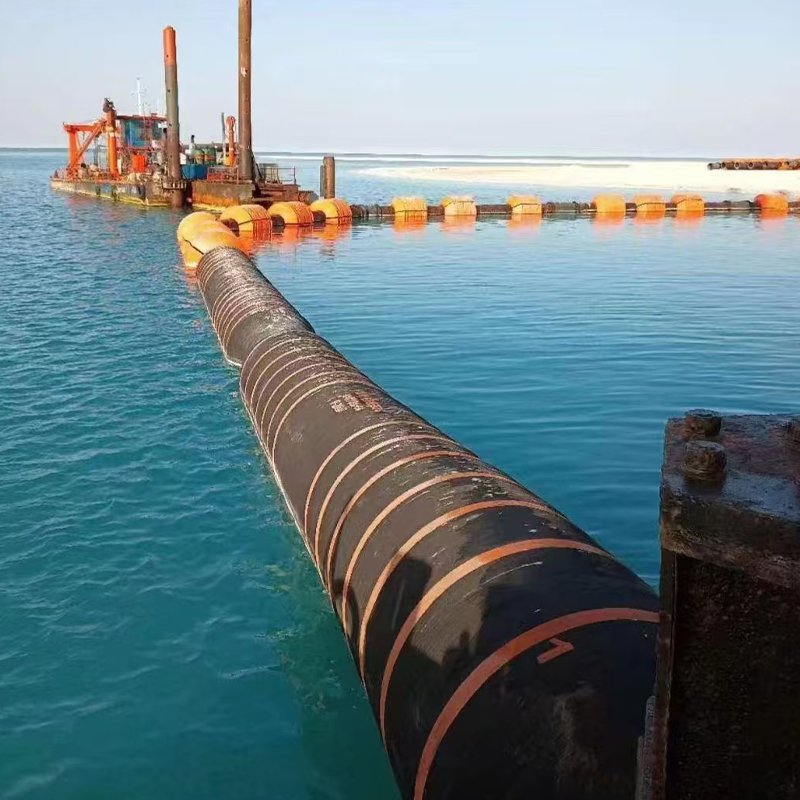
The inner rubber layer is one of the most core and critical functional layers of self-floating rubber hoses. It directly contacts the medium being transported (usually water), and its performance directly determines the service life, transportation efficiency, and safety reliability of the hose body.
I. Main Functions of the Inner Rubber Layer
1. Medium Conveyance: Acts as a channel for fluids (such as water, foam solutions, etc.).
2. Resistance to Medium Erosion: Must be able to withstand chemical corrosion, swelling, and degradation caused by the transported liquid.
3. Wear Resistance: Water flow may carry particles such as silt and sand; the inner rubber layer needs good wear resistance to prevent thinning or rupture due to wear.
4. Low Fluid Resistance: The inner wall is typically required to be smooth and flat to reduce water flow resistance and ensure transportation efficiency.
5. Airtightness: Ensures that the liquid does not leak through the rubber layer under design pressure.
II. Materials and Formulations of the Inner Rubber Layer
The inner rubber layer of self-floating rubber hoses usually uses synthetic rubber as the main material, with the most commonly used being:
• Styrene-butadiene rubber: Offers good comprehensive performance and excellent wear resistance, making it one of the most commonly used rubbers for inner layers.
• Chloroprene rubber: Has good oil resistance, aging resistance, flex resistance, and flame retardancy. It is selected when the transported medium has special requirements or when used in harsh environments.
Various additives are added to the rubber matrix to optimize its properties:
• Reinforcing agents: Such as carbon black, which significantly improves the wear resistance, strength, and tear resistance of the rubber compound.
• Antioxidants: Enhance resistance to ozone and weather aging, extending service life.
• Softeners and plasticizers: Improve processability, making the rubber compound more flexible and easier to form.
• Vulcanization system: Causes cross-linking of rubber molecules, forming a stable three-dimensional network structure, thereby obtaining excellent elasticity, strength, and durability.
III. Physical Property Requirements of the Inner Rubber Layer
Due to their common use in scenarios such as fire fighting, flood control, and agricultural irrigation, the inner rubber layer of self-floating rubber hoses needs to meet strict physical and mechanical performance indicators:
• High tensile strength: Can withstand working pressure and a certain degree of unexpected tensile force.
• High elongation at break: Has good flexibility and elasticity, adapting to operations such as bending and coiling.
• Excellent wear resistance: A key indicator, usually measured by Akron abrasion or DIN abrasion, with lower values being better.
• Good water resistance: Performance does not decline after long-term immersion in water, with no swelling, softening, or loss of strength.
• Certain pressure resistance: Works together with the reinforcement layer (such as polyester cord or high-strength canvas) to withstand internal water pressure without bursting or excessive expansion.
IV. Structural Design of the Inner Rubber Layer
In terms of structure, the inner rubber layer is tightly integrated with other parts of the hose:
1. Adhesion to the Reinforcement Layer: The inner rubber layer must have extremely strong adhesion to the adjacent reinforcement layer (such as polyester cord or high-strength canvas). Poor adhesion can lead to delamination of the rubber layer from the skeleton layer under pressure, causing bulging or hose bursting.
2. Thickness Uniformity: Uniform thickness of the inner rubber layer must be ensured during production. Too thin a layer is prone to early wear and damage, while too thick a layer increases costs and reduces hose flexibility.
3. Surface Smoothness: Through precise extrusion and mold control, the inner wall is ensured to be smooth to reduce head loss of water.
Summary:
The inner rubber layer of a self-floating rubber hose is far more than a simple ‘lining.’ It is a functionally designed and manufactured barrier that integrates multiple critical properties such as wear resistance, corrosion resistance, pressure-bearing capacity, and sealing. The material selection, formula design, and process level directly determine the quality grade and service life of the entire rubber hose. When selecting a self-floating rubber hose, understanding the material and performance parameters (such as wear resistance indicators) of its inner rubber layer is an important basis for judging its quality.
A high-quality inner rubber layer can ensure that the rubber hose maintains a long service life and reliable performance even under frequent use, dragging, winding, and harsh environments.