Detailed Explanation of Applications and Features of Slope Rubber Hoses
Ramp rubber hoses are a crucial component in the industrial sector, particularly in bulk material conveying systems. They primarily address issues such as material spillage, dust dispersion, and belt misalignment that occur when conveyor belts traverse \”humps\” or \”height differences\” at transfer points (e.g., from one piece of equipment to another). Below is a detailed explanation of the applications of ramp rubber hoses:
### I. Core Application Scenarios
The core application of ramp rubber hoses lies in \”sealed transfer,\” especially in inclined conveying sections. They are mainly used in the following scenarios:
1. Transfer points of belt conveyor systems: This is the primary application scenario. When two conveyor belts (usually flat belt conveyors) need to connect vertically and there is a certain height difference and inclination angle, an \”incline\” section is formed. Ramp rubber hoses are used to enclose this inclined conveying passage.
– Example: After unloading ships at a wharf, materials are conveyed via horizontal belt conveyors and need to be lifted to the reclaiming and stacking machine in the yard. The inclined sealed section connecting them uses a ramp hose.
2. Inlet/Outlet of bucket elevators: Connecting the inclined section between horizontal feeding equipment and the head or tail of vertical elevators to achieve sealed conveying.
3. Any connection requiring inclined, enclosed conveying of bulk materials: Used to connect two devices with height differences that require environmental protection.
### II. Key Problems Solved (Application Objectives)
1. Prevent material spillage and waste: In inclined sections, materials are prone to splashing and overflowing due to gravity. Rubber hoses provide a fully enclosed environment, ensuring all materials reach their destination, reducing economic losses and cleaning costs.
2. Control dust pollution, ensuring occupational health and environmental compliance: When conveying powdery or granular materials (such as cement, mineral powder, grains, and fertilizers), dust is easily generated. Ramp hoses effectively suppress dust emission, improve working conditions, and meet environmental regulations.
3. Prevent external contaminants from entering: They also prevent rainwater, dust, and other foreign objects from entering the conveyed materials, ensuring material cleanliness (e.g., for food and chemical raw materials).
4. Adapt to complex operating conditions:
– Compensate for deviations: Rubber’s flexibility can compensate to some extent for installation errors between equipment or minor misalignment during operation.
– Vibration and noise reduction: Absorb noise generated from material impact and equipment vibration.
– Adapt to incline angles: Typically adaptable to 0-60 degree or even larger incline angles.
### III. Typical Application Industries
They are almost applicable to all industries that handle bulk materials:
– Ports and wharves: Loading/unloading of coal, ore, grains, and fertilizers, as well as yard transfers.
– Power industry: Coal conveying systems in power plants, transporting coal from wharves or coal yards to boiler coal bunkers.
– Cement industry: Fully enclosed conveying of raw materials, clinker, cement, and fly ash throughout the process.
– Mining and metallurgy: Transfer of ore, concentrate powder, tailings, and sintered ore.
– Grain processing and storage: Elevating and storing grains such as wheat, corn, and soybeans to prevent loss and contamination.
– Chemicals and plastics: Conveying chemical raw materials such as plastic pellets, fertilizers, and caustic soda.
– Building materials: Conveying materials such as sand and gravel,Ceramic pellets, and gypsum.
IV. Product Features (Supporting Its Applications)
To meet the aforementioned stringent applications, incline rubber hoses typically have the following design features:
• Multi-layer structure:
◦ Lining layer: Abrasion-resistant materials (such as ultra-high molecular weight polyethylene, abrasion-resistant rubber) to resist material erosion.
◦ Reinforcement layer: Multiple layers of high-strength fabric (such as polyester canvas) or steel wire to withstand internal pressure and material weight.
◦ Cover layer: Rubber or synthetic materials with anti-aging, UV resistance, and weather resistance to protect the hose body.
• Excellent balance of flexibility and rigidity: It can be bent to the required angle during installation and maintain a tubular shape without collapsing when fully loaded.
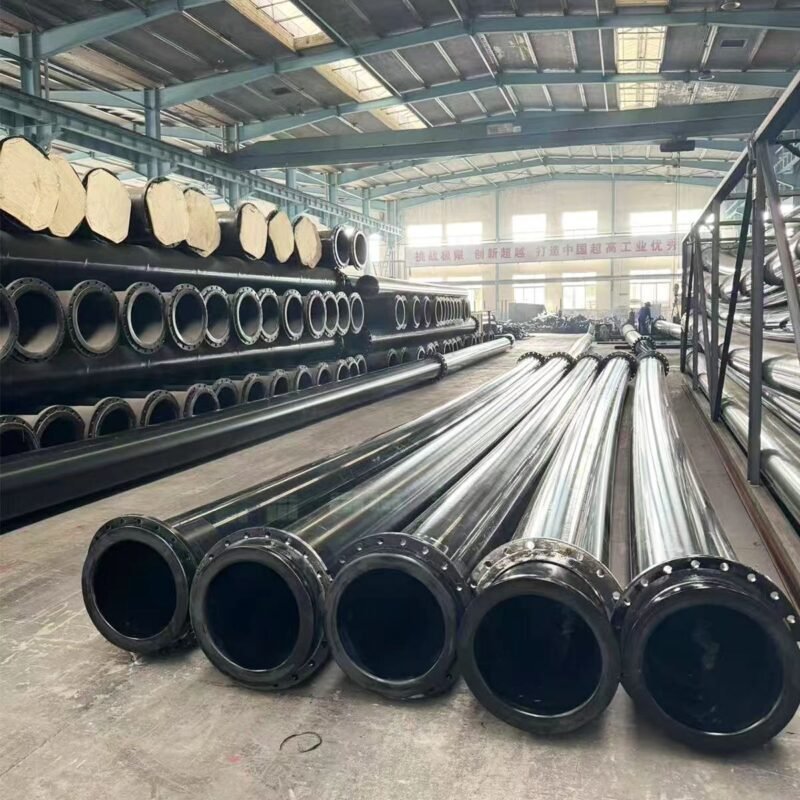
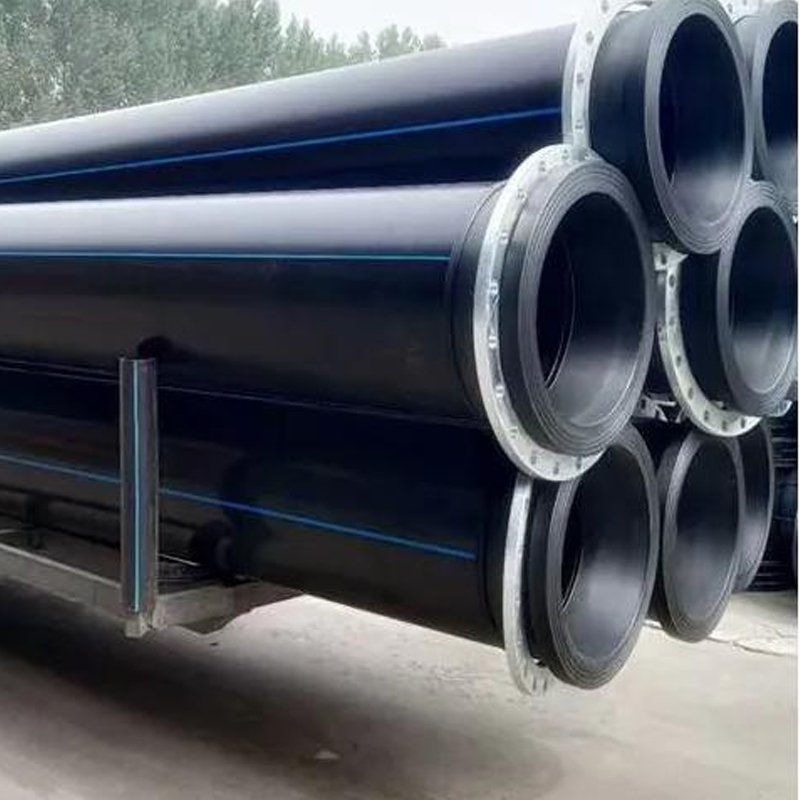
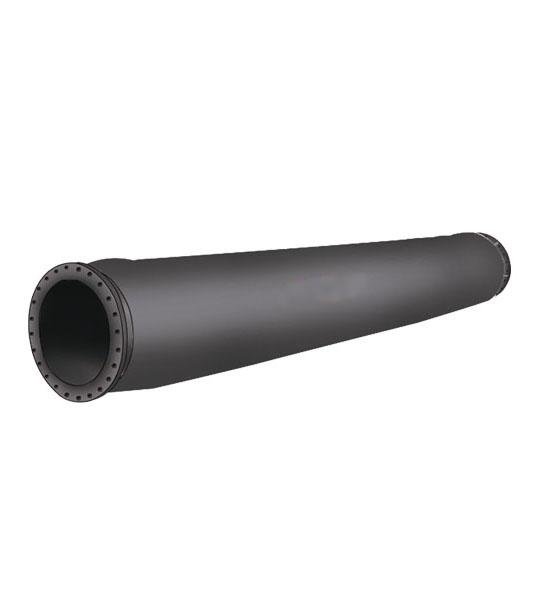
• Flange connection: Standard flanges are fitted at both ends for easy bolted connection with upstream and downstream equipment, ensuring good connection sealing.
• Optional features: Anti-static, oil-resistant, heat-resistant, flame-retardant, food-grade, etc., to adapt to specific industry requirements.
Summary:
Sloped rubber hoses are essentially ‘sealed sloped channels’ for bulk material conveying systems. Their core application is to achieve efficient, environmentally friendly, and leak-free transfer in inclined sections, making them an indispensable environmental protection and efficiency component in modern industrial bulk material handling systems. When selecting them, it is necessary to determine the hose’s size, structure, and material based on material properties (particle size, abrasiveness, specific gravity), conveying capacity, slope angle, and environmental conditions.