Construction Precautions for Rubber Expansion Joints in Dredging Engineering
Core Installation Notes
Notes Specific Instructions/Requirements
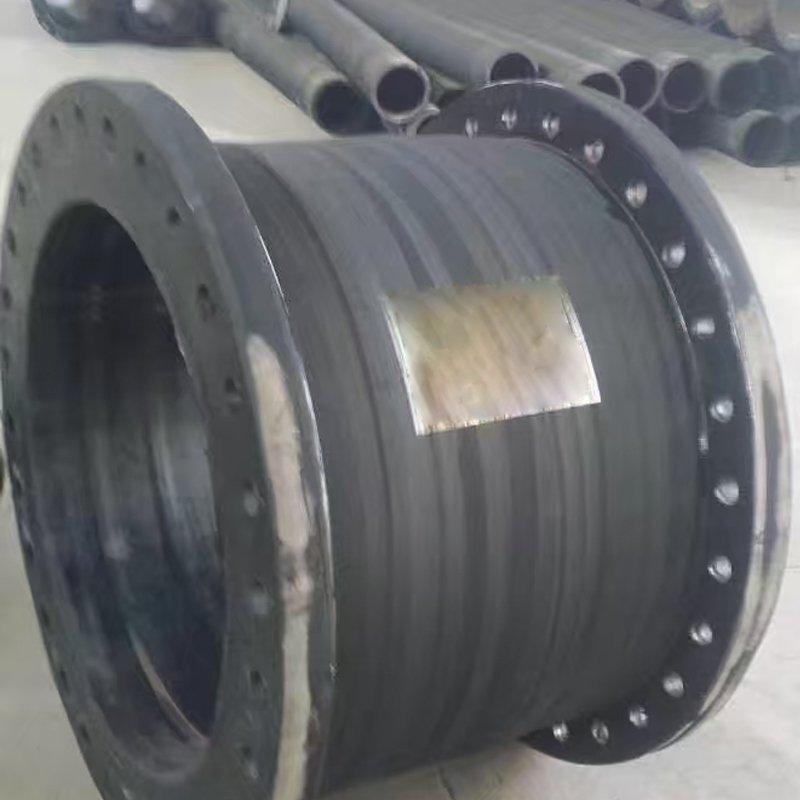
✅ Pre-Installation Verification and Inspection Confirm specifications (pipe diameter, pressure rating), material compatibility with medium (e.g., corrosion resistance) . Check rubber body for cracks, bubbles, and flanges for deformation .
✅ Positioning and Support Installation should prioritize straight pipe sections, with distance from bends/valves ≥5 times the pipe diameter . Fixed supports must be installed at both ends; auxiliary supports are required for large diameters (DN≥300); guide supports should be set 1-2 times the pipe diameter on both sides .
✅ Connection and Tightening Align flanges, ensure bolt holes are concentric (deviation ≤2mm) . Use stainless steel bolts, tighten in diagonal sequence in stages with uniform torque.
✅ Maintain Natural State After installation, the system must remain in a natural state; forced stretching or compression is strictly prohibited (pre-deformation amount ≤10% of rated compensation amount) .
❌ Strictly Prohibited: Exceeding Limits and Damage Exceeding compensation limits is strictly prohibited; avoid direct medium erosion of the rubber body; prevent sharp objects such as welding slag and burrs from scratching the rubber.
💡 Key Details and Special Condition Handling
In addition to the key point sin the table, the following details directly affect the performance and service life of rubber expansion joints.
• Pay attention to pipeline pre-treatment: Before installation, it is essential to clean weld slag and oil stains at the pipeline interface, ensuring the flange sealing surface is flat to prevent damage to the rubber sealing surface or leakage.
• Special Condition Response
◦ High-pressure systems (≥1.6MPa): It is recommended to select wire braided reinforced expansion joints and use high-strength bolts (such as grade 8.8 and above).
◦ Negative pressure (vacuum) systems: Vacuum-resistant expansion joints with internal support rings must be selected to prevent the rubber body from being sucked flat.
◦ High-temperature environments (>100℃): In addition to selecting heat-resistant rubber (such as EPDM), thermal insulation materials (such as glass fiber fabric) can be wrapped around the outside of the expansion joint to reduce the impact of thermal radiation.
🔧 Common Problems and Solutions
The following problems may occur during construction and operation and maintenance, which can be checked and troubleshooted accordingly:
• Leakage at the flange: This is usually caused by bolts not being tightened symmetrically or gasket aging. The bolts should be retightened in a diagonal sequence, or the medium-resistant gasket should be replaced.
• Abnormal deformation of the expansion joint: The main cause is the absence of fixed supports or excessive pre-stretching/compression during installation. Fixed supports should be added or reinforced, and reinstallation should be performed to ensure a natural state.
• Excessive vibration and noise: This is usually caused by the absence of guide supports or insufficient compensation. Guide supports can be installed, or the displacement amount can be verified to see if a model with a larger compensation capacity needs to be replaced.
• Rapid aging of rubber: If caused by excessive medium temperature, a rubber material with higher temperature resistance should be replaced; if caused by contact with corrosive media, the corrosion resistance of the material should be confirmed or anti-corrosion layers should be added to the pipeline.
📜 Standards and Maintenance Recommendations
• Reference specifications: Construction can refer to industry standards such as ‘CJ/T 208-2015 Flexible Rubber Joint’.
• Seasonal maintenance: In areas with large temperature differences, during winter installation, when rubber hardens, forced construction should be avoided; during summer high temperatures, check if bolts have loosened due to thermal expansion and retighten them in a timely manner.
I hope this information helps you standardize your construction. If you can provide more specific conditions (such as pipeline pressure, medium, and diameter), I may be able to provide a more targeted analysis.