Common Problems and Solutions for End-Suction Rubber Hoses
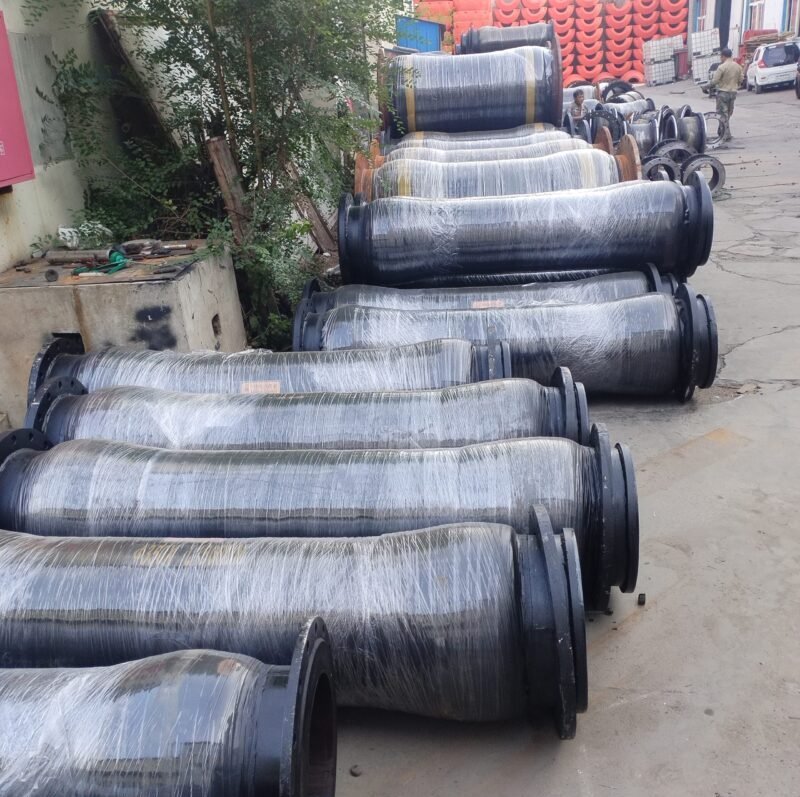
End suction rubber hoses (also known as sludge discharge pipes or suction pipes) are critical components in dredging projects. They come into direct contact with abrasive media such as mud, sand, and gravel, and their ends (i.e., the pipe mouth portion) are the areas that experience the most severe wear and are most prone to problems.
Below are common issues with end suction rubber hoses, their cause analysis, and corresponding solutions.
I. Common Problems and Cause Analysis
1. Excessive Wear and Perforation at the End
• Phenomenon: The rubber layer on the inner wall and outer edge of the pipe opening thins rapidly, and even holes appear, exposing the skeleton layer (such as fabric plies or steel wires).
• Causes:
◦ Abrasive Medium Erosion: Sediments and stones carried by water flow continuously and at high speed erode the pipe wall. The end has the highest flow velocity, resulting in the most severe wear.
◦ Cavitation: When bubbles form in the water flow and burst near the pipe wall, they generate enormous local impact forces that erode the rubber surface.
◦ Friction with Equipment or Hull: Improper friction occurs between the pipe opening and pump body interface, cutter head, or other pipe connections.
◦ Poor Rubber Material: The wear resistance and elasticity of the rubber are insufficient to withstand medium erosion.
2. Tear and Flap at the End
• Phenomenon: Longitudinal or transverse cracks appear at the edge of the pipe opening, with partial loss of rubber material.
• Causes:
◦ Mechanical External Impact: Struck or hooked by sharp underwater objects (such as rocks, metal debris).
◦ Improper Operation: During dragging or swinging of the pipe, the end rubs violently against hard surfaces (such as riverbeds, piers).
◦ Stress Concentration: Unreasonable design of pipe opening flanges or connectors leads to stress concentration at a specific point.
◦ Rubber Aging and Brittleness: Long-term exposure to ozone and sunlight causes the rubber to lose elasticity, making it prone to brittle tearing.
3. Leakage or Damage at End Joint/Flange Connection
• Phenomenon: Water or sand leaks from the connection between the pipe opening and flange; the flange itself deforms or bolts loosen.
• Causes:
◦ Insufficient Connection Strength: Insecure vulcanized bonding between the flange and pipe body, or uneven tightening force of the clamp bolts.
◦ Inappropriate Flange Material: Use of ordinary carbon steel flanges, which corrode rapidly in seawater, leading to seal failure.
◦ Installation Errors: Misalignment of two pipe flanges during connection, with forced tightening causing excessive local stress.
◦ Delamination of Rubber Layer and Skeleton Layer: Complex stresses at the end cause separation between the rubber and internal reinforcement layer.
4. Pipe Body Deformation and Collapse
• Phenomenon: The pipe body near the end is sucked flat, affecting flow efficiency, and may even be completely blocked.
• Causes:
◦ High Negative Pressure Suction: Excessive suction force of the pump exceeds the pressure-bearing capacity of the rubber pipe (especially negative pressure resistance).
◦ Damaged Skeleton Layer: Breakage of internal fabric plies or steel wires, losing support function.
◦ External Pressure: The pipe is squeezed by deep water pressure or buried objects.
II. Solutions and Preventive Measures
To address the above issues, three aspects should be considered: design selection, usage operation, and maintenance.
1. Optimizing Design and Correct Selection
• Enhance End Wear Resistance:
◦ Wear Rings/Guard Rings: Sulfurize and embed a more wear-resistant material (such as polyurethane or ceramic composite materials) around the inner or outer wall of the pipe end to form a \”sacrificial layer\” that protects the main pipe body.
◦ Thickened End Design:Special thickening of the rubber thickness in the end area to extend its service life.Special thicken the rubber thickness in the end area to extend its service life.
◦ Select Ultra-Wear-Resistant Rubber: Choose rubber hoses with high-hardness, high-wear formulas (such as natural rubber and butadiene rubber blending, with added carbon black, etc.).
• Enhance Structural Strength:
◦ Multi-Layer Skeleton Design: Use high-strength, high-density fabric (like cord fabric) or steel wire as the skeleton layer to improve pressure resistance, tensile strength, and negative pressure resistance.
◦ Optimize Flange Connection: Use heavy-duty flanges and ensure sufficient sulfurization bonding area and strength between the flange and the pipe body. It is recommended to use corrosion-resistant flanges (such as galvanized flanges, epoxy-coated flanges, or stainless steel flanges).
◦ External Reinforcement: Add external rubber armor or metal chains to protect the easily worn and torn areas at the ends.
2. Standardized Operation and Correct Usage
• Avoid Brutal Operation:
◦ When dragging or moving the pipe, avoid direct impact of the end on hard objects. Before underwater operations, try to explore the work area and avoid sharp obstacles.
◦ Control the swinging amplitude of the pipe to prevent severe friction between the end and the ship body, wharf, etc.
• Optimize System Configuration:
◦ Reasonably match the pump power with the pipe specifications to avoid excessive negative pressure causing the pipe to collapse.
◦ Install flexible compensators at the pump inlet to reduce vibration and stress.
• Regularly Rotate the Pipe:
◦ For fixed-installed pipes, rotate the pipe 120-180 degrees regularly (e.g., every 100-200 working hours) so that the worn areas are evenly distributed, which can significantly extend the overall service life.
3. Strengthen Maintenance, Inspection, and Timely Repair
• Daily Inspection: ◦ Before and after each operation, carefully check the end wear condition, signs of tearing, whether the flange connection is tight, and for corrosion.
• Timely Repair:
◦ For small-scale local wear or scratches, temporary repair can be done using specialized rubber repair agents/cold vulcanized glue.
◦ For large-scale wear, holes, or tears, send it to a professional manufacturer for hot vulcanization repair to ensure repair strength.
◦ Once the skeleton layer (cord yarn or steel wire) is exposed, stop using it immediately and repair it; otherwise, the damage will quickly expand.
• Proper Storage: ◦ When not in use, the pipe should be stored flat or coiled with a diameter larger than the specified minimum diameter to avoid folding. Keep it away from direct sunlight, ozone sources (such as motors), oil stains, and chemical substances.
Summary
The core issues of the end dredging rubber hose are \”wear\” and \”mechanical damage\”. The solution lies in:
• Pre-emptive Prevention: Choosing the \”right\” hose (wear-resistant, structurally strong, with reliable connections).
• In-Process Control: Performing \”standardized\” operations (avoiding impacts, controlling pressure).
• Post-Event Maintenance: Executing \”timely\” inspections and repairs. By taking these comprehensive measures, end problems can be minimized to the greatest extent, ensuring the continuity and economy of dredging operations.