Analysis of the Suction Function of Dredging Rubber Expansion Short Joints
Name Analysis We can break down this term into its components for understanding:
1. Dredging: This indicates its application field, i.e., used in projects such as mud excavation, sludge cleaning, and channel improvement.
2. Rubber: This specifies its main manufacturing material. Typically, high-strength, wear-resistant, and corrosion-resistant rubber (such as natural rubber, chloroprene rubber, nitrile rubber, etc.) is used. Sometimes, there may be a fabric layer or steel wire layer inside to enhance pressure-bearing capacity.
3. Expansion Short Connector: This is its core structure and function.
◦ Short Connector: Implies that it is a relatively short pipe fitting.
◦ Expansion: Refers to its ability to have certain axial compression and radial expansion. During installation, it can be compressed, thereby slightly increasing its diameter to tightly fill the connection gap.
4. Suction: Indicates that it is used in the suction pipeline, i.e., the part of the pipeline with negative pressure, for sucking materials such as mud and gravel from underwater.
In summary, a dredging rubber expansion suction short connector is a short pipe fitting made of rubber, used in the suction pipeline of dredging projects, with functions of axial compensation and vibration reduction.
Main Functions and Roles It plays a crucial role in dredging pipeline systems, mainly with the following functions:
1. Compensate for Displacement and Eccentricity:
◦ During dredging operations, dredgers (such as grab dredgers and hopper dredgers) sway with water flow and waves, causing relative displacement and angular deviation in the part connecting the dredging equipment and the main hull’s pipelines.
◦ Rubber expansion short connectors can utilize their flexibility to effectively absorb these displacements and deviations, preventing rigid pipes from being damaged due to excessive stress.
2. Vibration Reduction and Noise Reduction:
◦ When dredging pumps extract high-concentration mud mixtures, they generate intense vibrations and pulsations.
◦ Rubber components have good damping properties, which can significantly reduce the transmission of vibrations to the ship structure and subsequent pipelines, lower noise, protect equipment, and improve operational comfort.
3. Alleviate Water Hammer Phenomenon:
◦ When the pump’s operating conditions suddenly change or when a large object blocking the pipeline is suddenly cleared, destructive water hammer pressure is generated.
◦ The elasticity of the rubber expansion short connector can act as a buffer, absorbing part of the impact energy and protecting the entire pipeline system.
4. Facilitate Installation and Disassembly:
◦ Due to its flexibility and compressibility, the requirement for flange hole alignment during installation is relatively low, making it easier to install and adjust compared to completely rigid short connectors. It is also easier to disassemble when maintenance or component replacement is needed.
Structural Features
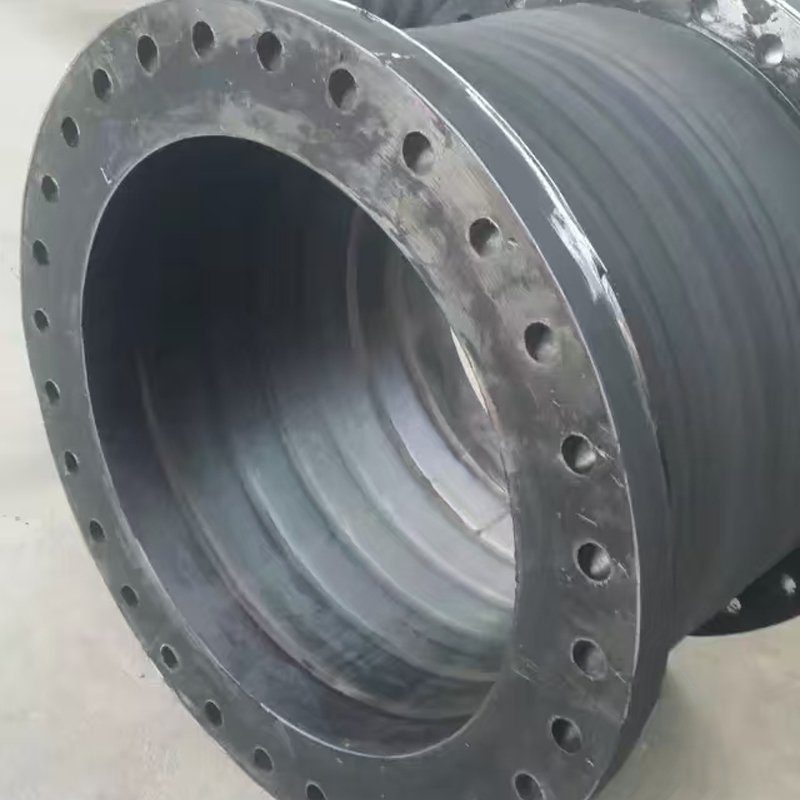
•Body: Made by vulcanizing high-strength rubber with reinforcement layers (such as nylon fabric or steel wires) to ensure pressure-bearing capacity and durability.
• Flange Ends: Both ends usually have steel flanges for connecting to the rigid pipeline flanges of the system.
• Anti-Disengagement Devices: Since it operates under negative pressure, to prevent the rubber component from being crushed by atmospheric pressure or pulled out, internal anti-disengagement steel ropes or anti-disengagement limit rings are typically designed to pull the two flanges, ensuring the shape and connection are maintained when subjected to negative pressure.
Application Scenarios:
It is mainly applied to:
• Cutter Suction Dredgers: The critical location connecting the cutter bridge frame and the main suction pipe of the ship’s body.
• Grab Suction Dredgers: Installed at the connection between the grab arm and the ship’s suction pipe.
• Other types of dredgers and shore-based slurry discharge pipelines where compensation and vibration reduction are required.
Summary:
In short, the slurry rubber expansion short joint is an unassuming but crucial flexible connecting component in dredging projects. It acts like a \”joint\” and \”shock absorber\” in the pipeline system, ensuring that the entire heavy-duty, high-load dredging pipeline can operate safely, stably, and efficiently under complex dynamic conditions through its own flexible deformation. Hope the above explanation helps you fully understand this component. If you have more related questions, feel free to ask!