Analysis of Application Scenarios for Live Flange Dredging Rubber Hoses
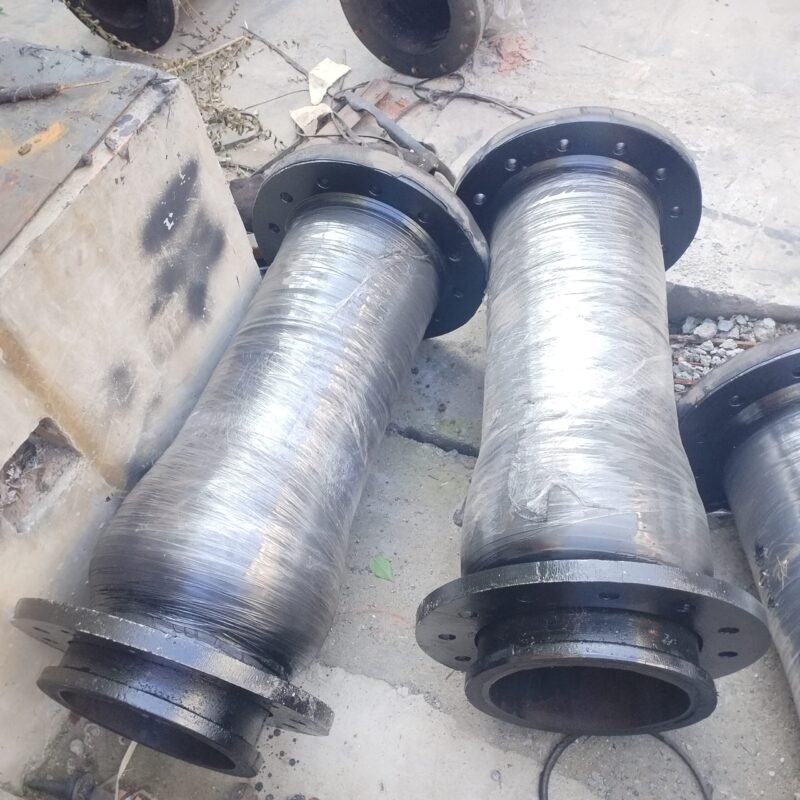
The flexible flange dredging rubber hose (also known as the flexible flange type slurry discharge hose) is a critical flexible connecting component in dredging projects. Its core application scenarios are positions with dynamic displacement and vibration, such as dredgers and hydraulic conveying systems, where it serves as a connector between pipes .
To help you better understand its specific usage, here are several main application locations summarized:
Application Location Main Functions and Scenario Description Notes/
Features Mud Discharge Pipeline of Dredger
Used to connect the dredger’s mud discharge pipe with floating pipes on water or shore pipes, to adapt to the ship’s movement, swaying, and wave impact .
This is the most important and typical application, with its active flange design specifically designed to solve pipeline misalignment issues on ships .
Connection Between Shore Pipe and Floating Pipe on Water
Installed at the junction of floating mud discharge pipes on water and fixed shore mud discharge pipes, compensating for displacement caused by water level changes, water flow, and floating body oscillation .
This location is often used in conjunction with spherical joints, expansion pipes, etc., to form a flexible ‘hinged’ system .
Temporarily Pipelines Requiring Frequent Disassembly
Used in construction sections that require frequent movement, assembly, or replacement of pipelines, such as segmented river dredging, land reclamation projects, etc. .
Its design reduces the difficulty of assembling or replacing pipelines and improves work efficiency .
💡 Why is it needed in these places?
Traditional rigidly connected steel pipes are prone to excessive stress due to misalignment and twisting in these dynamic positions, leading to leaks or even damage at the connection points. In contrast, the flexible flange dredging rubber hose solves the problem of misalignment and twisting that often occurs during pipeline replacement or connect through its unique movable flange design. Additionally, the rubber hose itself has good wear resistance and flexibility, able to withstand the scouring of sand and gravel in slurry. Its structure also often includes a steel wire spiral layer to ensure strength and pressure resistance.
🔍 How to select and learn more In practical selection, besides determining the application scenario, attention should also be paid to specific technical parameters:
• Material: The lining is usually wear-resistant natural rubber (NR), and some use ethylene propylene diene monomer rubber (EPDM) to enhance aging resistance.
• Structure and Pressure: The pipe body has a steel wire skeleton or spiral steel wire reinforcement layer, with common working pressure ranges between 10-25 bar (Bar).
• Size: There are many inner diameter specifications, ranging from common several inches to over 700 millimeters (about 28 inches) used in large engineering projects.
• Temperature: The general applicable working temperature range is around -20°C to +50°C-2.
If you want to learn more about specific pipeline system configuration schemes for particular projects (such as large port dredging or small river channel cleaning), I can provide more detailed information for you.